
According to the regulations of the Civil Aviation Authority of Vietnam, from 1 July 2026, passengers may carry a maximum of 2 power banks on board, but they must be placed in carry-on baggage and must not be checked in. Lithium-ion batteries with a capacity of ≤100 Wh are permitted; those over 100 Wh up to 160 Wh require prior approval from the airline. Lithium metal batteries must contain no more than 2 g of lithium.
1. Regulations on carrying power banks on board
The Civil Aviation Authority of Vietnam has issued the latest regulations on carrying power banks on board to enhance passenger and crew safety, effective from 1 July 2026. Accordingly, passengers are permitted to carry power banks on board but must strictly comply with the following regulations to ensure aviation safety:
1.1. Quantity
Each passenger is permitted to carry a maximum of 2 power banks in carry-on baggage, and they must not be placed in checked baggage.
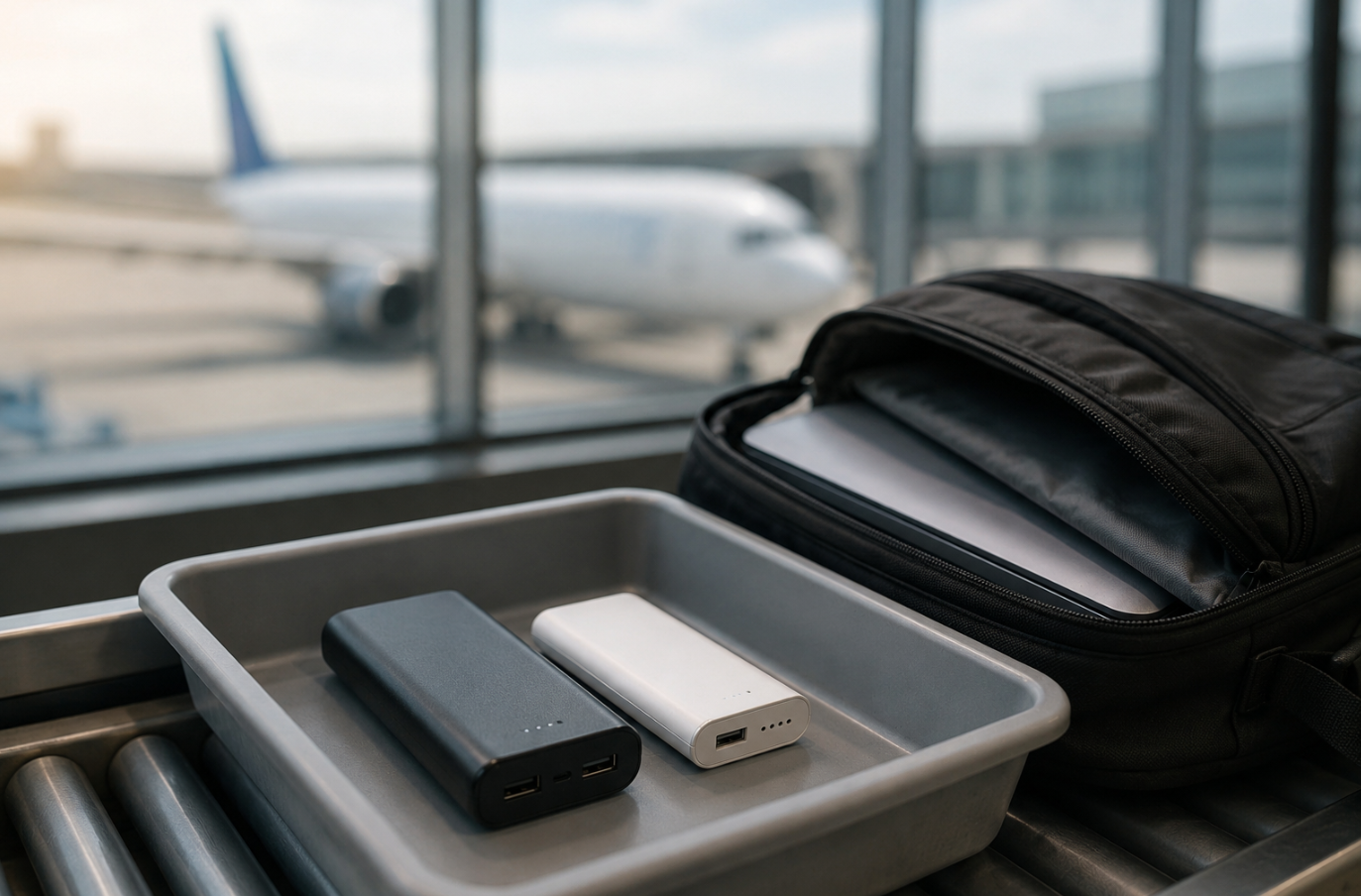
Under the latest regulations, passengers may carry a maximum of 2 power banks on board.
1.2. Rated energy and lithium content
Power banks containing lithium metal batteries must have a lithium content of no more than 2 g.
Power banks containing lithium-ion batteries must have a rated energy of no more than 100 Wh. Where the rated energy is over 100 Wh up to 160 Wh, carriage must be approved by the airline in advance before the flight.
If the power bank only indicates its capacity in mAh, the battery voltage must be known to convert it to Wh using the following formula:
|
Wh = (mAh × V) / 1,000 |
|---|
Accordingly, 100 Wh is equivalent to approximately 27,000 mAh at 3.7 V. As the voltage may vary, the same mAh capacity may correspond to different Wh levels. Therefore, passengers should check the Wh rating indicated on the power bank to determine the applicable carriage conditions.
1.3. Where to place the power bank
The power bank must be removed from carry-on baggage and placed in a clearly visible location. Throughout the flight, passengers must not charge the power bank or use the power bank to charge other electronic devices.
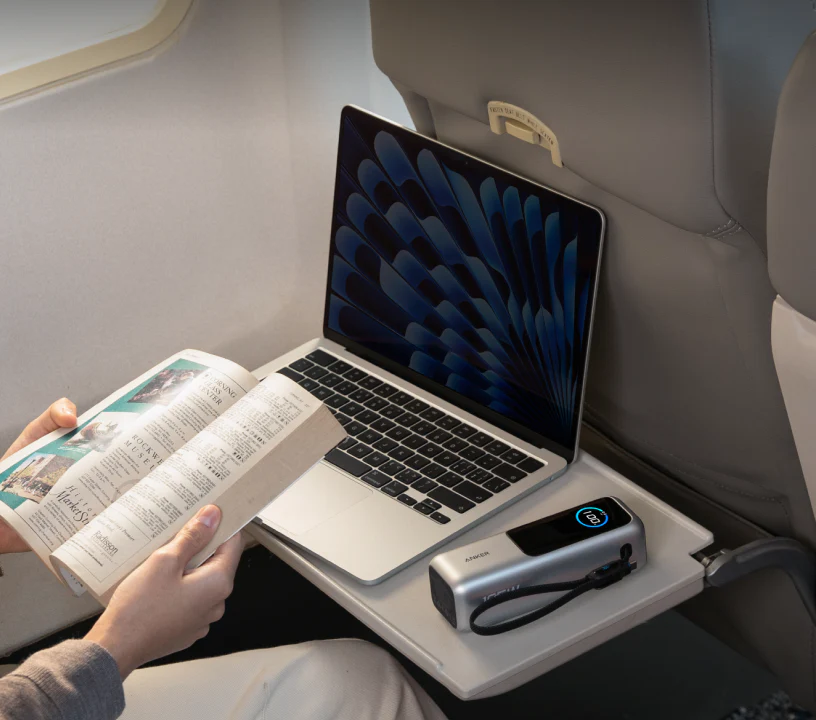
You should place the power bank in an easily visible location, such as on the tray table at your seat.
1.4. How to protect a power bank when carrying it on board
The power bank must be individually protected against short circuits. It may be placed in the manufacturer's retail packaging, insulated or have exposed terminals covered with protective tape, or each power bank may be placed separately in a plastic bag or a dedicated protective pouch.
2. Regulations on carrying power banks on Sun PhuQuoc Airways flights
Power banks are permitted on Sun PhuQuoc Airways flights when they meet the applicable rated energy (Wh) or lithium content (g) limits and corresponding carriage conditions. Passengers may refer to the following regulations to check their power banks before the flight.
|
Rated energy (Wh) – Lithium-ion battery |
Lithium content (g) – Lithium metal battery |
Classification |
Carry-on baggage |
Checked baggage |
Carrier approval required |
|---|---|---|---|---|---|
|
≤ 100 Wh |
≤ 2 g |
Battery installed in a portable electronic device (PED) or portable medical electronic device (PMED) |
Yes (1) |
Yes (*) |
No (1) |
|
≤ 100 Wh |
≤ 2 g |
Spare battery |
Yes (2) |
No |
No (2) |
|
≤ 100 Wh |
≤ 2 g |
Power bank |
Yes (3) |
No |
No (3) |
|
> 100 Wh and ≤ 160 Wh |
— |
Battery installed in PED or PMED |
Yes |
Yes |
Yes |
|
> 100 Wh and ≤ 160 Wh |
— |
Spare battery |
Yes (4) |
No |
Yes |
|
> 100 Wh and ≤ 160 Wh |
— |
Power bank |
Not permitted for carriage |
— |
— |
|
— |
> 2 g and ≤ 8 g |
Battery installed in PMED |
Yes |
Yes |
Yes |
|
— |
> 2 g and ≤ 8 g |
Spare battery for PMED |
Yes (4) |
No |
Yes |
|
> 160 Wh |
> 8 g |
Battery/device |
Not permitted for carriage |
Not permitted for carriage |
— |
Notes:
(1) Each passenger may carry a maximum of 15 portable electronic devices (PEDs). If carrying more than 15 PEDs, carrier approval is required.
(2) Each passenger may carry a maximum of 20 spare batteries of all types.
(3) Each passenger may carry a maximum of 2 power banks.
(4) Each passenger may carry a maximum of 2 spare batteries.
(*) If the device is carried as checked baggage, the device must be completely switched off and must not be left in sleep or hibernation mode. An exception applies when:
-
The lithium content does not exceed 0.3 g for devices containing lithium metal batteries.
-
The rated energy does not exceed 2.7 Wh for devices containing lithium-ion batteries.
(**) If smart baggage is checked in, the lithium battery must be removed and carried as carry-on baggage.
3. Important notes when carrying a power bank on a flight
When bringing a power bank on board, make sure to carefully check the information on the power bank, do not use it during the flight, switch off the power bank and always remove it when undergoing security screening.
-
Check the information clearly: The power bank must be a genuine product with clear information about the manufacturer, capacity (mAh) and power rating (Wh) displayed on the product. Products without labels or technical specifications will be refused for carriage.
-
Do not use the power bank on board: Although power banks are permitted on board, passengers must not use them to charge other devices throughout the flight. This regulation is intended to prevent the risk of fire or explosion caused by the battery heating up during charging.
-
Prepare for security screening: When passing through the security checkpoint, you must remove the power bank from your carry-on baggage and place it in a separate tray for screening, similar to a laptop.
-
Switch off the power bank: Before boarding the aircraft, make sure that your power bank is completely switched off.
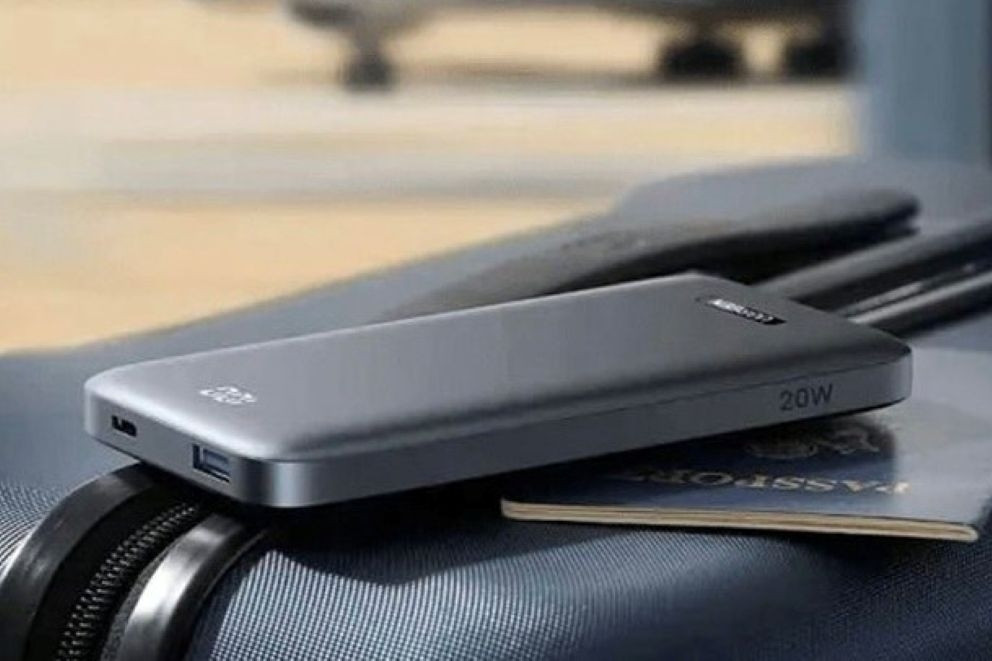
Remember to completely switch off your power bank once you are on board to ensure safety.
4. Frequently asked questions
4.1. Why are power banks subject to strict controls when carried on board?
Power banks are subject to strict controls because they use lithium-ion batteries, which carry a high risk of fire or explosion if damaged, short-circuited or manufactured to poor quality standards. Strict controls are necessary to ensure flight safety. These regulations help minimise risks and enable the crew to respond promptly if an incident occurs.
4.2. Can a 30,000 mAh power bank be carried on board?
You may carry a 30,000 mAh power bank on board if it has been approved by the airline. A 30,000 mAh power bank typically has a capacity of 111 Wh to 150 Wh (above the standard threshold) and therefore requires prior approval from the airline before being carried on board.
4.3. Can a power bank be placed in the overhead baggage compartment?
You are permitted to place a power bank in the overhead baggage compartment, as this is still considered part of the carry-on baggage area within your control. However, for ease of inspection or in case an incident needs to be addressed, you should keep it in an easily accessible location, such as in your personal bag or the outer compartment of your backpack.
4.4. Can I bring a power bank when travelling to China?
When flying to China, you are permitted to bring a power bank but must comply with the country's strict regulations. The power bank must have clear technical specifications, and products without labels or with unclear information are not permitted. In addition, capacity limits similar to international regulations also apply.
4.5. Do I need to declare a power bank when checking in for my flight?
Under the regulations on carrying power banks on board, power banks with a capacity below 100 Wh do not need to be declared during check-in. However, if your power bank has a capacity from 100 Wh to 160 Wh, you must declare it to the airline for review and prior approval before the flight. If it is not declared, your power bank will be refused for carriage at the security checkpoint.
Power banks may be carried on board if you comply with the latest regulations on quantity, capacity and protection. Understanding these rules not only helps ensure a smooth journey but also contributes to the overall safety of the flight.